
 Fast Shipping to most US states! & Local delivery within 250 miles
  phone support
 Maker project watch
Someone Is Building a Real Space Cadet Pinball Machine
Australian maker CNCDan is turning the Windows-era digital table into a physical, mechanical build with custom 3D-printed parts. It is a wonderfully ambitious hobby project, and it is still under construction.
Editorial illustration. Authentic footage and creator thumbnails appear below.
A digital table is becoming real hardware
For many Windows users, 3D Pinball: Space Cadet was an accidental introduction to pinball. The table originated in the 1995 PC game Full Tilt! Pinball before one table became familiar through its inclusion with Windows.
CNCDan, also known as Daniel McKenzie, is approaching that memory as an engineering problem: if the on-screen table never had to obey real-world dimensions, how do you build mechanisms that make its impossible geometry playable?
A compact physical layout
The reported working layout is roughly one meter long with a playfield about 56 centimeters wide, leaving little room for standard pinball parts.
Custom parts by necessity
Pop bumpers, drop targets, slingshots, flippers, and other assemblies are being redesigned around the virtual table's proportions.
Iteration is the real story
The videos show prototypes that fail, mechanisms that improve, and the compromises required to turn software behavior into physical motion.
Where virtual pinball meets real physics
A video game can pause a ball, shrink a bumper, or route a return lane without worrying about wires, switches, gravity, or service access. The physical build has to solve every one of those details.
The upper playfield calls for bumpers much smaller than normal commercial assemblies, so the build uses custom printed mechanisms.
Early switch behavior led to experiments with magnetic Hall-effect sensing, showing how much hidden engineering sits beneath a simple hit.
A custom mechanism recreates the familiar moment when the virtual ball pauses before returning from the raised playfield.
Prototype flippers have required more work around force, coil control, and durability before they can behave like dependable pinball hardware.
Watch the machine take shape
These are CNCDan's own build videos, embedded and credited here as fan and maker coverage. Parts one and two establish the compact layout and early mechanisms. Parts three and four document working wormholes and further physical-table revisions. The machine remains an independent hobby project, not a commercial release.
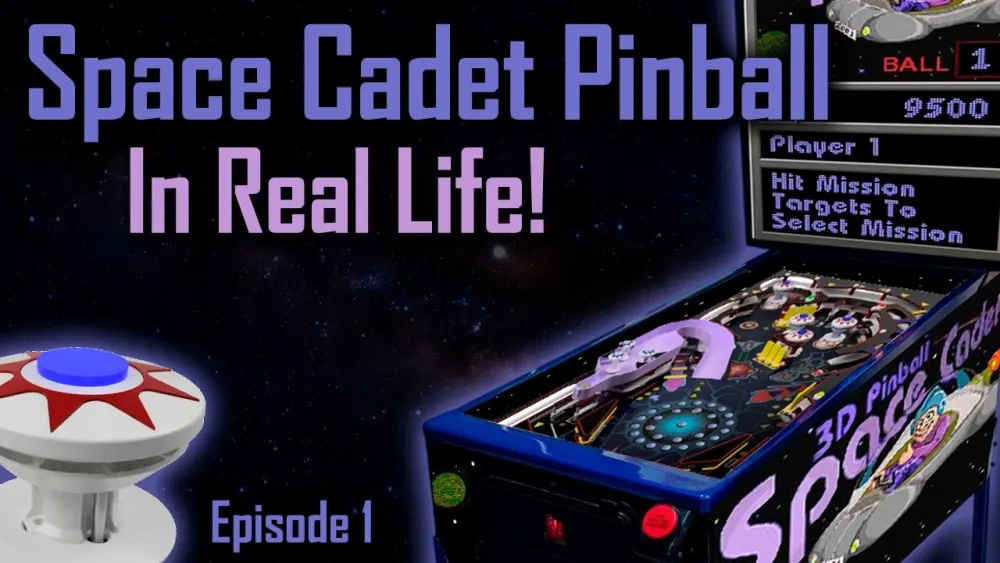
The first physical mechanisms
Scaling the table, testing custom bumpers, and beginning the translation from pixels to parts.
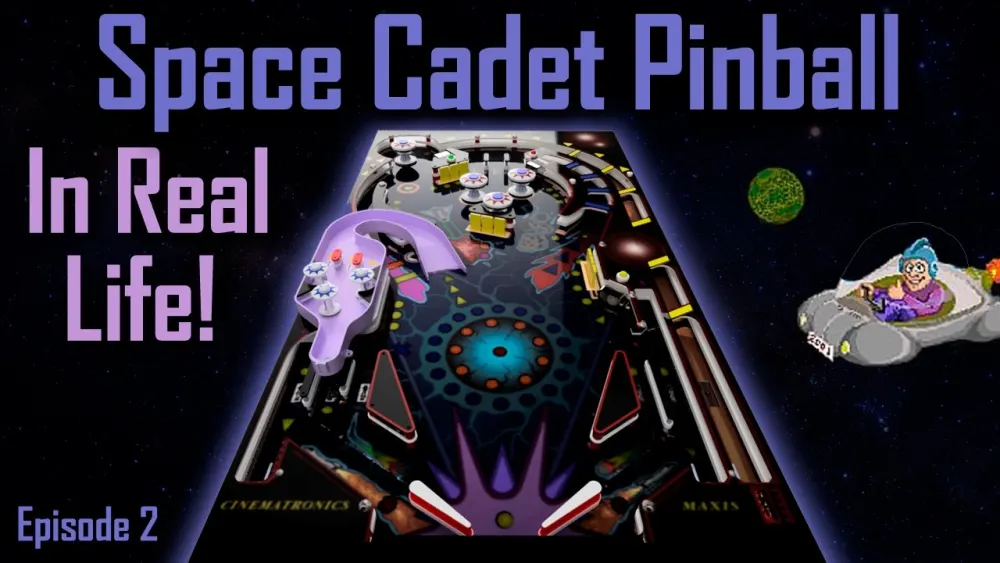
More mechanisms, more lessons
Continuing the build with revised hardware, stronger tests, and more of the table's unusual behavior.
Working wormholes
CNCDan tests functional wormholes in a full-scale table.
See part 3 in the seriesRefining the build
Further flipper and slingshot revisions, plus wormhole and black-hole mechanism work.
See part 4 in the seriesThis is not a machine announcement
There is no manufacturer release, retail price, preorder, production schedule, or indication that this one-off project will become a commercial product. Evolution Pinball is covering it because the nostalgia and engineering are remarkable, not because a Space Cadet machine is available to buy.
LEGO pinball on Amazon
Shop the LEGO pinball listing
Amazon inventory and seller contents can change. Confirm whether LEGO Icons set 11374 or a compatible lighting or accessory product is included before purchasing.
Paid link. As an Amazon Associate I earn from qualifying purchases.